
If there are little or no cash receipts on a given day, but customers pay by card and give a tip that is immediately withdrawn from the cash register, the cash register balance may fall below the defined fixed cash register balance. This is fundamentally not an error and does not need to be corrected – here we explain why this happens and what options you have if you still want to avoid it.
How it happens
If a customer pays by card and gives a tip, this tip is usually withdrawn from the cash register immediately in cash and handed to the employee (see Book tip by card payment). If there were no or only few cash receipts on that day otherwise, more cash is withdrawn from the register than was received. The actual cash register balance drops accordingly below the set amount.
Example from a daily closing:
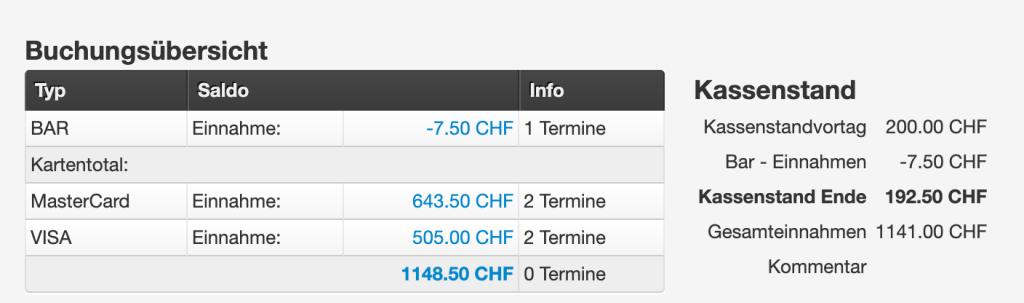
The previous day's cash register balance was 200.00 CHF – this is the fixed cash register balance for this business. On that day there were hardly any cash payments: the line "CASH – Receipt" even shows a negative value of -7.50 CHF because a tip paid by card was withdrawn from the register without sufficient cash receipts to cover it. The cash register balance at the end is therefore only 192.50 CHF and thus below the fixed cash register balance of 200.00 CHF – even though the total receipts of 1,141.00 CHF (almost entirely by MasterCard and VISA) were very good that day.
This is expressly not the same as a negative cash register balance: A negative cash register balance only occurs when more money is to be withdrawn than is actually in the register – the daily closing cannot then be saved at all. Falling below the fixed cash register balance, on the other hand, is only a deviation from the desired target value: the actual balance remains positive (192.50 CHF in the example above) and the daily closing can be saved normally.
There is also the option of not withdrawing the tip immediately, but leaving it in the register first ("Keep tip in register", see Tip rules). However, this option is used much less frequently in practice than immediate withdrawal.
No need to worry – it evens itself out
Fundamentally, it is not a problem if the cash register balance temporarily falls below the fixed cash register balance. As soon as there are cash receipts again on one of the following days, less money is automatically withdrawn from the register than is received on that day – until the difference is made up and the fixed cash register balance is reached again. You don't need to do anything for this.
If the cash register balance should remain constant anyway
If you still want to avoid the cash register balance temporarily deviating from the fixed value, there are the following options:
1. Book a deposit for the difference
You can book a cash register deposit in the amount of the missing difference to immediately replenish the cash register balance to the fixed value. This is usually only worthwhile for very small amounts, as the money must actually be deposited by someone – usually the owner. If no suitable deposit template already exists, it must first be created under Cash › Expenses › Templates (see the section "Add and manage expense templates" in the linked article).
2. Activate automatic replenishment
In the settings for the fixed cash register balance there is the option "Replenishment":
If this option is enabled, Belbo automatically books a safe withdrawal if necessary to replenish the cash register balance to the set target value. Of course, this requires that there is actually enough cash available in the safe.
3. Disable tip withdrawal
Alternatively, you can generally disable immediate tip withdrawal (option "Keep tip in register" in the Tip rules) and instead pay out the tip paid by card in the evening or transfer it collectively at the end of the month. This is the most fundamental of the solutions, as it permanently changes the process in day-to-day operations, and should therefore be considered carefully.
4. Do nothing
You can simply leave the deviation as it is. As described above, the cash register balance automatically evens itself out once cash receipts occur again – a cash register balance is allowed to fall below the fixed cash register balance without any action being required.