
belbo
  • Overview
    • Getting to know Belbo
    • Location Settings
    • Switch to Belbo
    • Calendar View & Navigation
    • Recurring Appointments & Courses
    • Appointment Entry & Management
    • Tasks
    • Overview
    • Multiple Locations & Head Office
    • Manage Employees
    • Logins
    • Rights
    • Overview
    • Absences & Holidays
    • Working Hours
    • Time Tracking
    • Overview
    • Data Protection (GDPR)
    • Customer Communication (Email, SMS)
    • Customer Management & Records
    • Overview
    • Bonus & Loyalty Programs
    • Campaigns (Newsletter & SMS)
    • Marketing Consents (GDPR)
    • Tracking & Analytics
    • Overview
    • Services & Prices
    • Service Packages & Subscriptions
    • Vouchers
    • Products
    • Purchase & Vendors
    • Stock & Inventory
    • Scanning & Sales
    • Cost of Goods & Expenses
    • Overview
    • Design & Texts
    • Setup & Settings
    • Integration (Website, Google, Instagram, Facebook)
    • Online payment
    • Overview
    • Accounting & Exports
    • Cash Register Settings & Hardware
    • Checkout process
    • Daily Closing & Reports
    • TSE & Cash Register Anti-Tampering Ordinance
    • Overview
    • Export Overview
    • Employee Utilization
    • Revenue & Reports
    • Belbo Satellite
    • Printer
    • EC Terminal & Card Payment
    • Troubleshooting Hardware
    • Scanner & POS Devices
    • General Settings
    • API & Integrations
    • Notifications & Emails
    • Contracts & Legal
Skip to content
Statistics & Reports›Overview

Customer liability

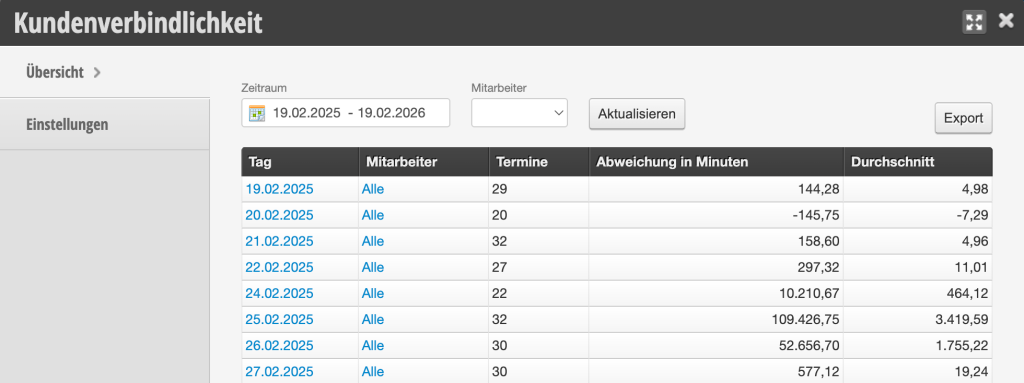
The function provides an evaluation option based on appointments recorded in the calendar and the associated cash transactions. It serves to analyze how reliably customers keep their scheduled appointments.

How it works

For a defined time period, the sum of time deviations (in minutes) between the planned appointment end time and the time of the last cash transaction is calculated.

The following applies:

Only appointments for which a cash transaction has been recorded are taken into account.
For each individual appointment, the difference between the stored appointment end time and the last associated cash transaction is determined.
The identified deviations are summed up for the selected time period and displayed as a total value.
The statistics make it possible to make deviations transparent and evaluate appointment behavior in a structured way. For example, recurring delays or deviations can be identified and organizational measures can be derived.
Categories: Overview

Have a question? Ask it here.

This manual is a service by belbo. Legal notice